Chess.com’s Authentication Flow — What’s Missing and How to Fix It
Chess was one of the first games I truly fell in love with as a child. I grew up playing chess. It was one of those rare games that teaches you more than how to win — it teaches you how to think. Years later, with online platforms redefining how chess is played and shared, I decided to create an account on Chess.com and return to a game that had long stayed with me.
During the signup process, I noticed an unexpected detail — there was no OTP or verification step required to create an account.
Out of curiosity, I entered a random email address and a password, expecting the platform to ask for verification — perhaps an OTP, a confirmation link, or some form of validation. Surprisingly, none of that happened. The account was created successfully without verifying whether the email actually belonged to me.
I am not entirely certain whether this behavior is intentional, a temporary issue, or a recent change in the signup flow. However, based on my past experience, Chess.com previously required email confirmation during account creation. I have observed this behavior consistently over the past four to five days.
This observation led me to look deeper into Chess.com’s authentication flow — not to criticize a platform, but to understand what makes an authentication system strong, what happens when key steps are missing, and how such systems can be improved.
This article takes a theoretical yet practical approach to explore:
- What Chess.com’s current authentication flow looks like
- What mistakes exist in the flow
- The vulnerabilities such mistakes introduce
- What an ideal authentication system should do
- How platforms like Chess.com can fix these issues
Observing the Authentication Flow
At a high level, authentication is meant to answer a very simple question:
“Is this user really who they claim to be?”
In Chess.com’s signup process, the flow currently allows:
- Any email address (valid or invalid)
- With Password
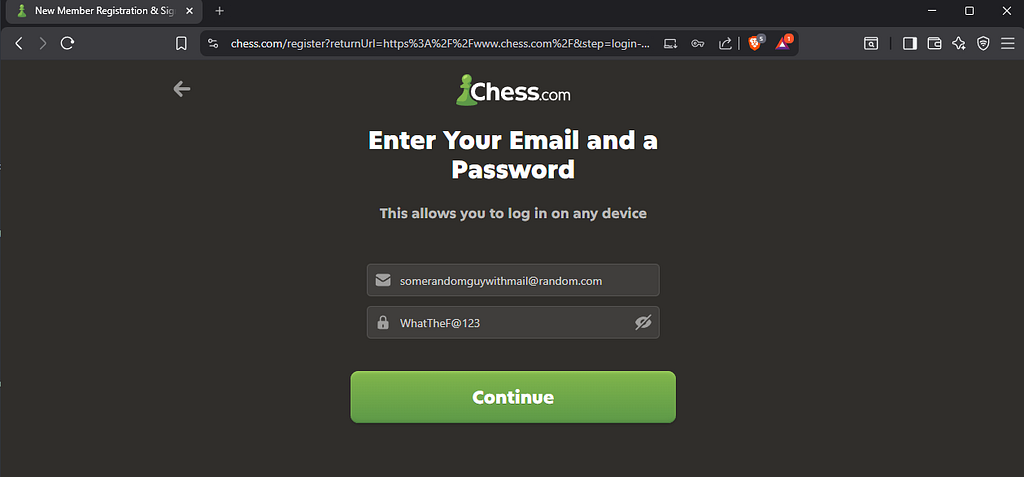
I entered this as email and password
- Immediate account creation without verification

wallah! i can choose username
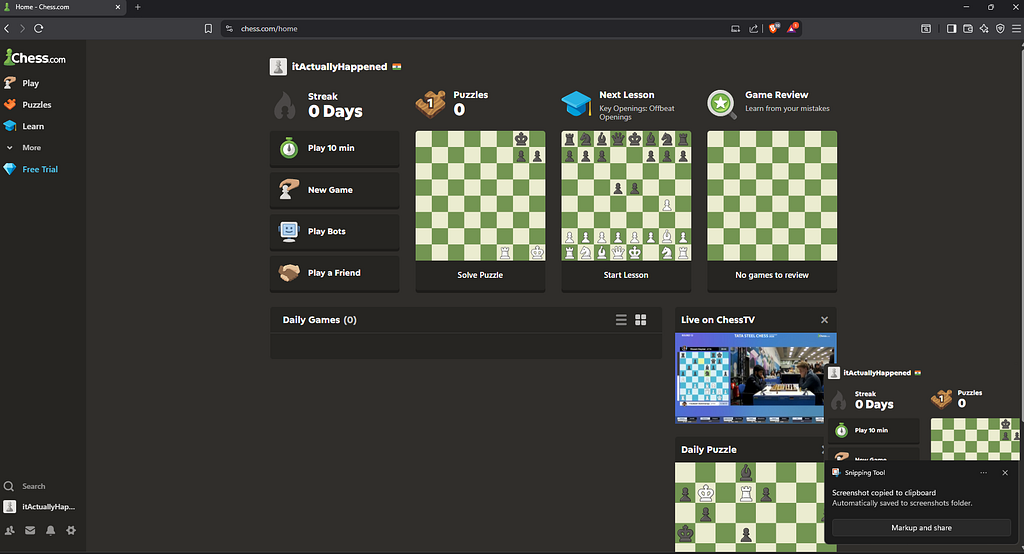
Fully Working chess.com account without even giving any valid credentials
There is no immediate requirement for:
- Verification of the email address
- OTP-based validation
- Proof of ownership of the provided email
- Even a valid, mailable email address
From a user experience perspective, this feels smooth and frictionless. But from a security and system design perspective, it raises important questions.
Where the Authentication Flow Goes Wrong
The primary mistake here is treating identity input as identity proof.
Typing an email address is not the same as proving ownership of that email. A good authentication system must distinguish between:
- User-provided claims (email, username)
- Verified identity signals (OTP, confirmation links, tokens)
In this flow, Chess.com accepts the claim but skips the verification.
This leads to multiple design-level issues:
- No confirmation that the user can receive emails
- No guarantee that the account can be recovered later
- No barrier against automated or fake account creation
While this may seem like a small omission, its impact scales quickly on large platforms.
Vulnerabilities Introduced by Weak Authentication
When authentication systems skip verification, vulnerabilities are not always immediate — but they compound over time.
1. Fake and Disposable Accounts
Anyone can create multiple accounts using temporary or non-existent email addresses. This enables:
- Spam
- Abuse
- Rating manipulation
- Platform pollution
2. Account Recovery Problems
If a user mistypes or intentionally enters a fake email:
- Password recovery becomes impossible
- Support systems are burdened
- Users permanently lose access to accounts
3. Impersonation Risks
An attacker can register accounts using someone else’s email address. Even if no harm is intended initially, this breaks the trust model of identity.
4. Weak Trust Signals
- Authentication forms the foundation for critical platform systems.
- Anti-cheat mechanisms rely on knowing who the players are.
- Abuse detection depends on accountable users to monitor and prevent harmful behavior.
- User reputation is tied to verified identities.
- When identity verification is weak, all these systems become less effective.
- The platform’s overall security, fairness, and user confidence are compromised.
- Weak authentication undermines the integrity of the entire ecosystem.
5. Wasting Resources
- Weak or missing authentication increases the likelihood of fake or duplicate accounts, which the platform must manage.
- Support teams may spend extra time handling account recovery issues for users who entered invalid or unverified emails.
- Automated systems — like anti-spam or anti-cheat mechanisms — must process more noise, reducing efficiency.
- Resources spent on monitoring and cleaning up fake accounts could be better used to improve platform features or user experience.
- Overall, weak authentication creates operational overhead, increasing costs and decreasing platform efficiency.
What Is an Ideal Authentication System?
To understand how to fix these issues, we need to step back and look at authentication theoretically.
At its core, authentication systems are designed to minimize identity uncertainty.
An ideal authentication system should:
- Verify identity ownership
- Prevent automated abuse
- Balance security with usability
- Enable reliable account recovery
- Scale with platform growth
In simple terms, authentication should not just allow access — it should establish trust.
Core Components of a Good Authentication Flow
1. Email Verification
A verification link or OTP ensures:
- The email exists
- The user owns it
- Communication channels are valid
This is the most basic trust signal.
2. OTP-Based Validation
Time-based OTPs (via email or SMS) add a second layer of confirmation, especially during:
- Signup
- Password reset
- Suspicious logins
3. Bot Prevention
- CAPTCHAs help ensure that only humans, not automated scripts, can create accounts.
- Rate limiting restricts how quickly accounts can be created from the same source.
- These measures reduce the risk of spam, abuse, and large-scale fake account creation.
- Without bot prevention, platforms may face operational strain and degraded user experience.
- Implementing these controls strengthens the overall integrity and trustworthiness of the system.
4. OAuth-Based Login
- Allowing users to log in via trusted providers such as Google, Apple, or GitHub transfers identity verification to platforms with strong authentication systems.
- This reduces the risk of fake accounts and impersonation.
- It also reduces friction for users, making signup faster and more convenient.
- OAuth-based login can improve account security while maintaining a smooth user experience.
- By leveraging trusted providers, platforms can focus on other security measures instead of building verification from scratch.
5. Progressive Trust Building
- New accounts can have restrictions until verification is complete.
- Features such as public interactions, competitive play, or certain advanced functionalities can be temporarily limited.
- This approach reduces the risk of abuse while maintaining a smooth onboarding experience for legitimate users.
- Progressive trust building allows platforms to gradually grant access as user identity is verified.
- It balances security with user convenience, strengthening overall platform integrity.
How Chess.com Can Fix Its Authentication Flow
Rather than redesigning everything, Chess.com could make incremental improvements:
- Require email verification before account activation — I think they use to do it but I don’t know what happened now.
- Delay full access until verification is complete
- Add CAPTCHA during signup
- Flag unverified accounts internally
These changes are low-cost, high-impact, and widely used across modern platforms.
Importantly, such fixes do not harm user experience — they improve long-term platform health.
Why This Matters Beyond Chess.com
Chess.com is just a case study.
The real lesson applies to any digital platform:
Small authentication shortcuts, when scaled to millions of users, become systemic weaknesses.
Good authentication is not about being strict — it’s about being intentional.
Final Thoughts
Authentication systems are like opening moves in a chess game. A weak opening doesn’t always lose immediately — but it creates vulnerabilities that skilled opponents will eventually exploit.
By observing real-world systems like Chess.com’s signup flow, we gain valuable insights into how authentication should be designed: step by step, verified, and trust-aware.
Strong platforms are built not just on features, but on foundations.
Authentication is one of those foundations — and getting it right matters.
Related Articles
Understanding the Tradeoff Between Reads and Writes in Databases and Why You Can’t Optimize Both at the Same Time
A clear explanation of the read/write tradeoff in databases and its impact on performance decisions.
How I Reduced API Latency by Using Caching
A practical look at caching strategy that reduced latency and stabilized backend performance.
From Monolith to Microservices: Breaking the Big Snowball into Many Rolling Pebbles
Explore how and why companies transition from monolithic architectures to microservices — and what that means for building apps that stay fast, reliable and easier to manage as they grow